mc-ASTRA
multicellular Analysis of Sample Tissue Representations and Associations

mc-ASTRA (mc_astra, commonly imported as mca) is a Python package for building interpretable maps of tissue and sample variability from single-cell and spatial omics data.
It integrates molecular, compositional, and spatial tissue descriptors together with sample-level information, such as clinical variables or technical covariates, to identify the main sources of variation across a collection of tissues. Using flexible factor models and downstream biological interpretation, mc-ASTRA connects these differences to coordinated multicellular programs and changes in tissue organization.
The package provides modular workflows for preprocessing, constructing multi-view tissue representations, fitting and exploring tissue-state maps, and interpreting the multicellular processes underlying them. It integrates with the scverse ecosystem, uses MOFA-FLEX for flexible factor modeling, and supports the incorporation of biological and technical prior knowledge.
Installation
mc-ASTRA currently targets Python 3.12 and 3.13. mc-ASTRA currently targets the dev branch of MOFA-FLEX: https://github.com/bioFAM/mofaflex.git@main.
Install mc-ASTRA latest development version:
PyPI installation coming soon!
Import the package as:
Patient-level representations of tissue state
Current molecular measurements are typically acquired at the level of genes and cells, but the biological and clinical question is defined at the level of the patient or tissues. A central challenge is therefore to construct representations that summarize how a tissue is organized and perturbed in each individual, while remaining comparable across cohorts and technologies.
A useful abstraction is to represent each patient as a point in a space of tissue states, where variation reflects coordinated biological processes rather than isolated features. This requires moving beyond single-cell resolution alone and explicitly modeling how signals are structured across cell types within a tissue.
Multicellular programs as an initial formulation
An initial step in this direction is the definition of multicellular programs: latent variables capturing coordinated gene expression changes across multiple cell types.
These programs:
- Encode coupled responses across cell types, rather than independent effects
- Provide a low-dimensional representation of patient variability
- Are robust to differences in cell-type composition and technical noise
- Enable alignment of bulk and single-cell data within a shared space
This formulation shifts the focus from which genes change in which cells to which coordinated processes define the tissue state of a patient.
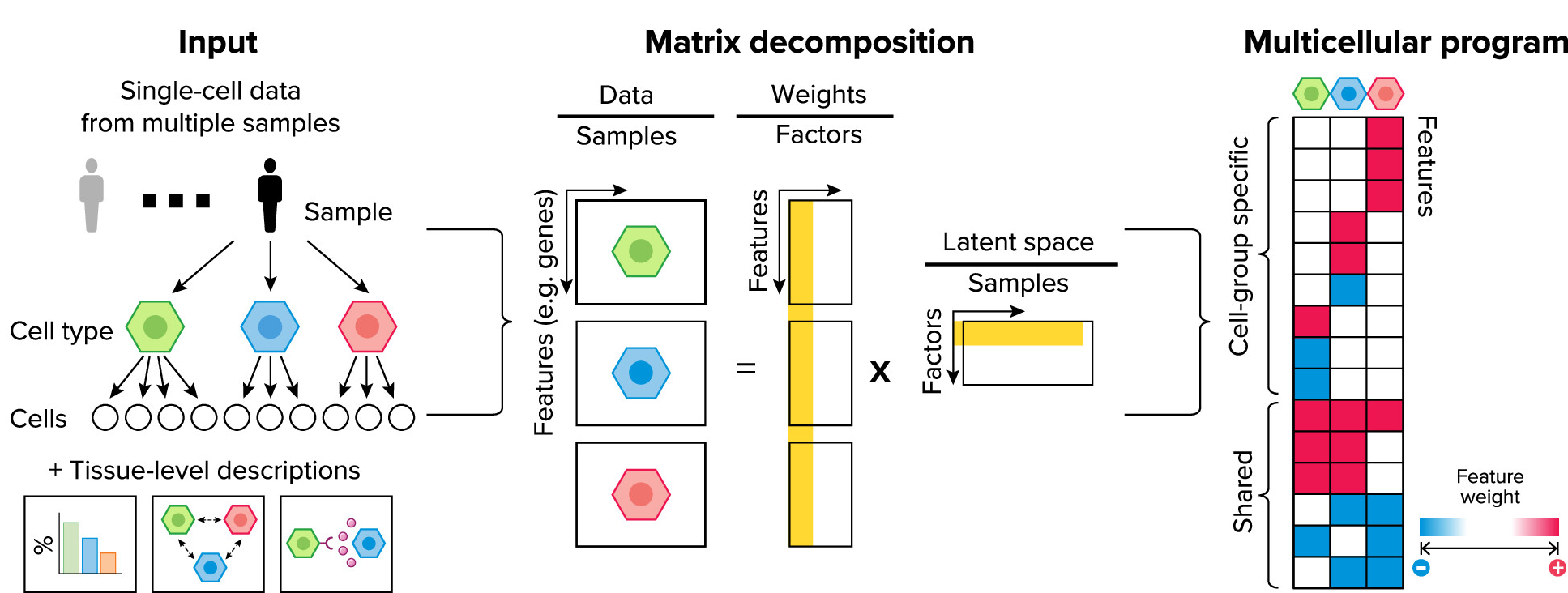
Reconstruction of multicellular programs from single-cell data. Adapted from Ramirez Flores, et al. 2024. Physiology
Generalization to tissue descriptor modeling
Multicellular programs are one instance of a broader concept: tissue descriptors. These are quantitative summaries of different aspects of tissue organization that can be defined per patient.
Relevant descriptors include:
- Gene expression per cell type
- Cell-type composition
- Cell–cell communication patterns (e.g. ligand–receptor activity)
- Pathway or regulatory activities
- Spatial organization
Each descriptor captures a different facet of tissue biology. The key objective is not to analyze them in isolation, but to model their joint variation at the patient level.
Within this perspective, multicellular programs act as a latent representation that integrates across descriptors, rather than a standalone endpoint. They provide a scaffold to understand how different aspects of tissue organization co-vary.
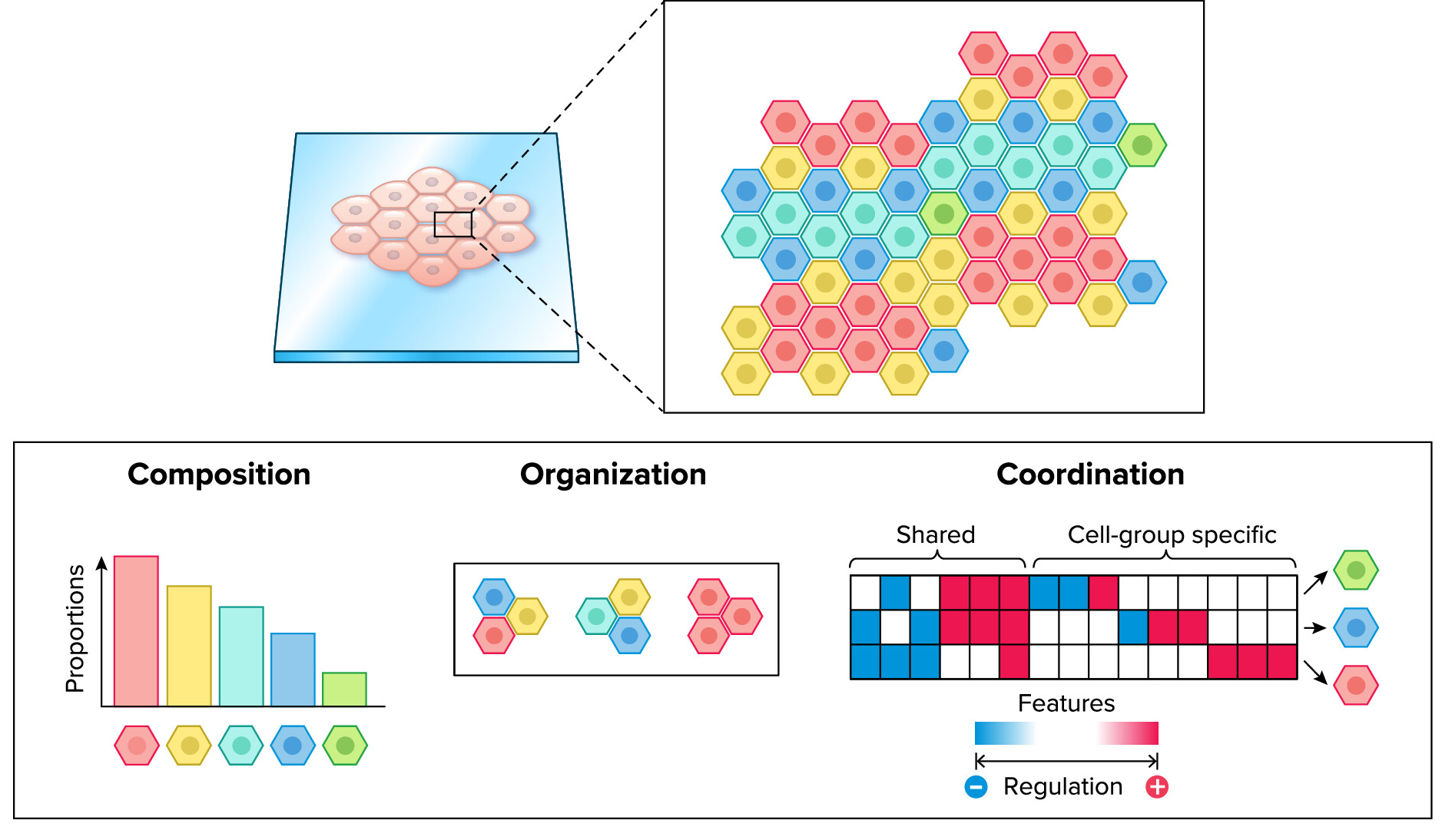
Reconstruction of multicellular programs from single-cell data. Adapted from Ramirez Flores, et al. 2024. Physiology
Why factor models
Factor models provide a natural framework for this problem because they are designed to capture shared structure across heterogeneous, high-dimensional data.
In this context:
- Each tissue descriptor (e.g. expression in a cell type, communication scores) is treated as a view
- The model learns a set of latent factors that explain covariance across these views
- These factors represent tissue-level axes of variation, i.e. patient-level states
This enables:
- Integration of multiple descriptors within a single model
- Separation of shared biological variation from descriptor-specific effects
- Dimensionality reduction with interpretability, via factor loadings
- Projection of new samples into the learned latent space
Conceptual summary
The framework can be summarized as a progression:
- Patient representation problem: define comparable, interpreable summaries of tissue state
- Multicellular programs: capture coordinated gene expression across cell types
- Tissue descriptors: generalize to multiple complementary views of tissue organization
- Factor models: provide the statistical machinery to integrate these views into coherent patient-level representations
This positions patient heterogeneity as variation along latent axes of multicellular organization, rather than as independent changes in genes or cell types.
What's new?
mc-ASTRA is a python package that expands the functionalities provided in our R implementation and in LIANA+.
mc-ASTRA simplifies the pre-processing of single cell data, connects to new models available in MOFA-FLEX, and enables new downstream analyses and creation of custom tissue descriptor views (e.g. spatial).
Particularly it enables the guidance of factors using information of samples and features as presented in other factor models.
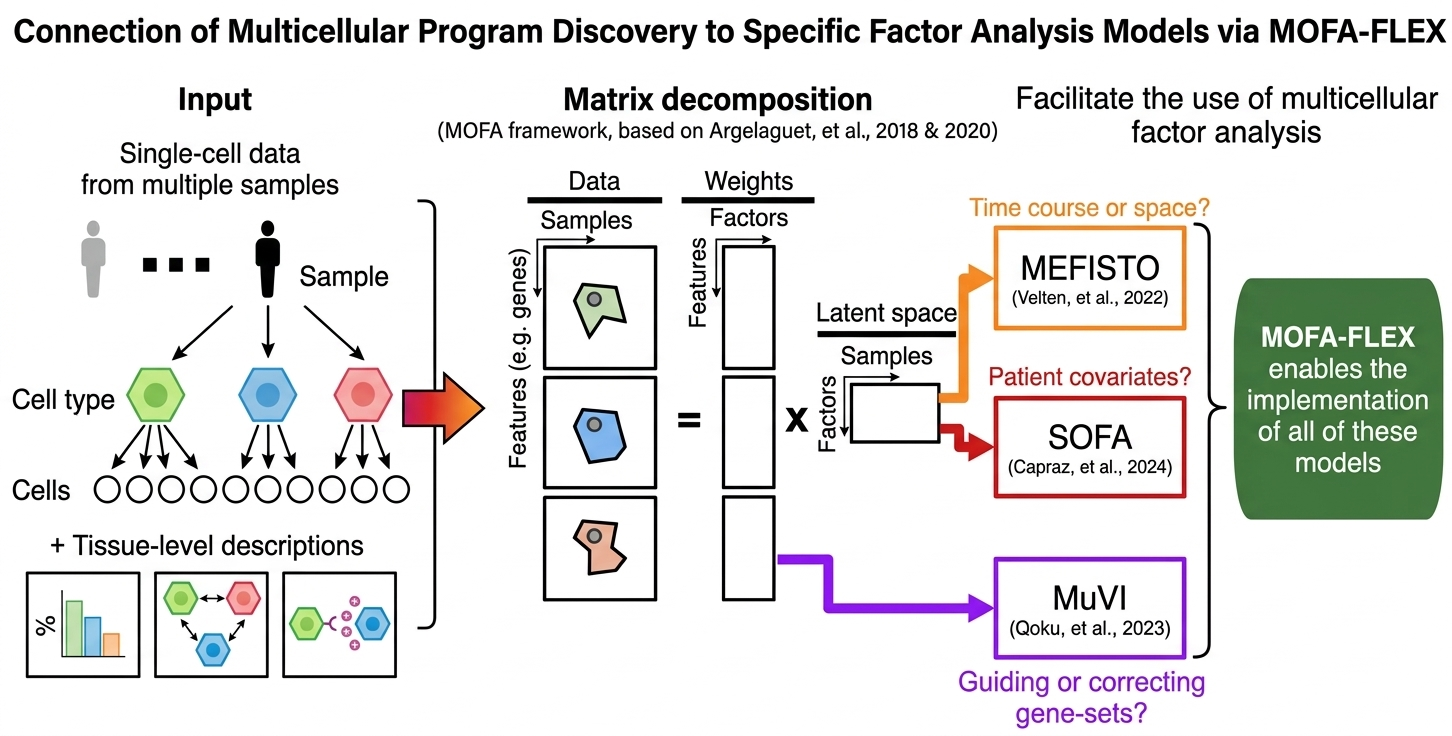
Reconstruction of multicellular programs from single-cell data. Adapted from Ramirez Flores, et al. 2024. Physiology
Documentation Map
- Start with the collection of vignettes that explain the basics of multicellular factor analysis.
- Explore the API reference.
- See contributing for local development and docs builds.
Citation
Ricardo Omar Ramirez Flores, Jan David Lanzer, Daniel Dimitrov, Britta Velten, Julio Saez-Rodriguez (2023) Multicellular factor analysis of single-cell data for a tissue-centric understanding of disease. eLife 12:e93161.